
Technical SEO for Persian and RTL sites: ZWNJ, slugs, hreflang and what Google sees
Building a site for Persian or Arabic readers? Great content only ranks when the technical basics underneath are right.
Founder & CTO, Parslinks
Say you're a European agency asked to launch a Persian version of a client's site for the diaspora market. Translators deliver great copy. Three months later, the Persian pages barely rank, and the English pages seem to compete with them.
None of it is about content quality. It's a handful of technical details that are invisible unless you know Persian script, and they're all fixable.
1. Look-alike characters
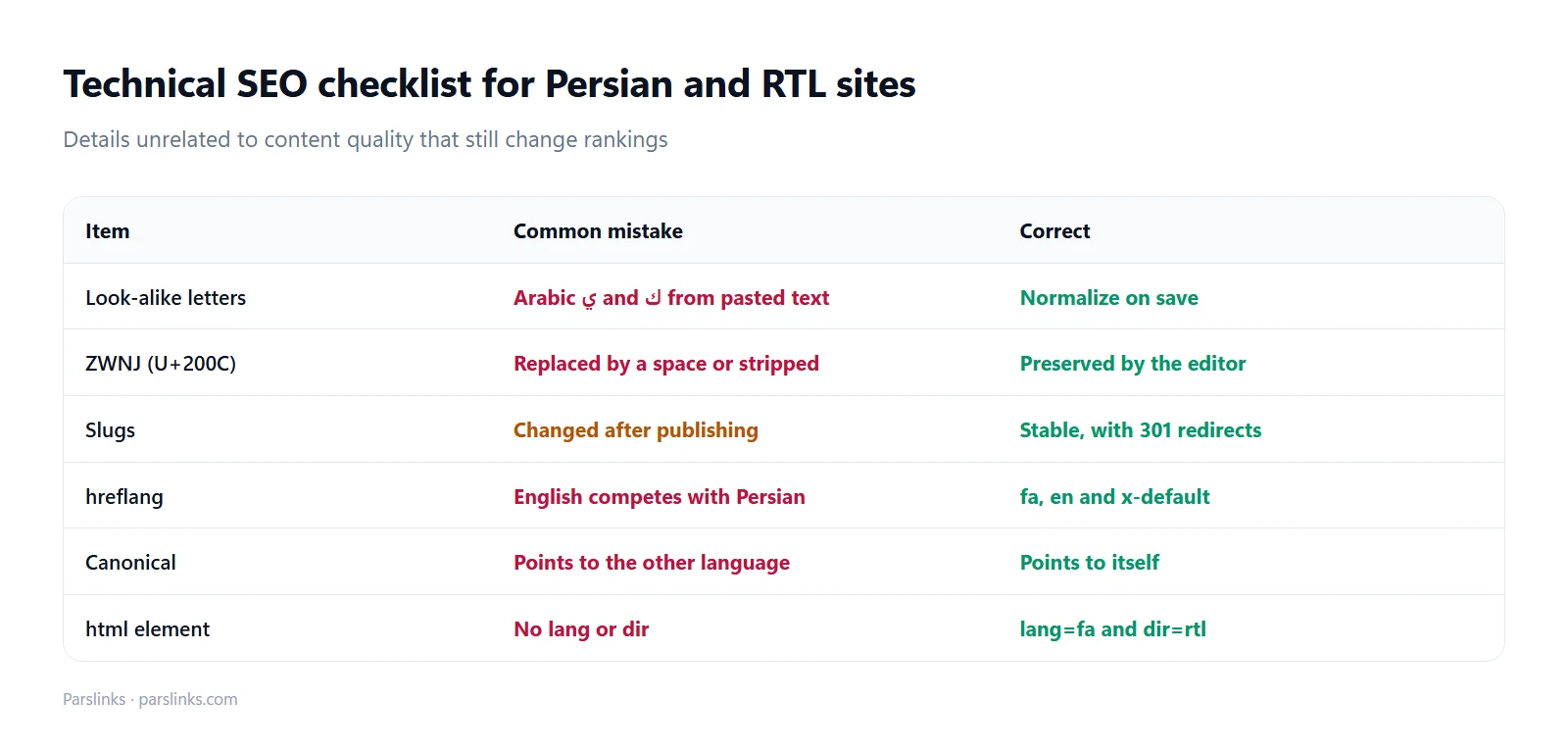
Persian and Arabic share an alphabet, but two letters have different Unicode code points in each: the Arabic ي and ك versus the Persian ی and ک. They look nearly identical. Text pasted from Arabic keyboards or old documents often contains the Arabic versions, so the same word can exist in two spellings. Search engines partly compensate; your site's internal search probably won't.
The fix: normalize to the Persian characters when content is saved, once for existing content and always for new content.
2. The zero-width non-joiner
Persian uses an invisible character, the ZWNJ (U+200C), to separate parts of a word without a visible space. The same word can be written correctly with a ZWNJ, incorrectly with a space, or joined together. Inconsistent spelling hurts readability and how consistent your text looks to search engines. Make sure your CMS editor and any sanitizer keep the ZWNJ rather than stripping it.
3. Persian or Latin slugs?
A Persian slug reads nicely in the address bar, but once copied into a chat or email it becomes a long %D8%A7... string. A Latin slug stays clean everywhere.
Both get indexed. Consistency matters more than the choice: don't change a slug after publishing, and if you must, add a 301 redirect.
4. Bilingual sites: hreflang
If a page exists in Persian and English, tell search engines they're translations of each other, not two competing pages:
Each version must list all versions, including itself. And each page's canonical must point to itself, not to the other language. If the English page's canonical points to the Persian one, Google drops the English page.
5. Titles, descriptions and share images
Every page needs a unique title of about 50–60 characters with the key phrase first, and a meta description of about 150. For links to render well in Telegram, WhatsApp and LinkedIn, which are big channels for Persian audiences, fill in Open Graph tags: og:title, og:description and an og:image of roughly 1200×630.
The outcome
On our own blog, every article has a Persian and an English version, linked with hreflang, each with its own canonical and share image. The English versions aren't translations; they're adapted for their readers, which is exactly what hreflang expects. If you're still deciding where your blog should live, see subdomain or subfolder.
Frequently asked questions
Join the discussion
No comments yet. Be the first to share your thoughts.
Related posts
- Guides
Subdomain or subfolder for your blog and app docs?
When you launch a blog or docs next to your app, the first question is where they live. This post looks at what each choice means for SEO, cookies and login, Search Console and deployment, and shows how to run a subfolder without merging projects.
- Platform
Static site or server rendering? Cost and speed in practice
We built a 30-page marketing site with a CMS twice: once static, once server-rendered. This post puts the numbers side by side, shows where static wins, where SSR is necessary, and how ISR gets you the best of both.
- Guides
Connecting a domain to your app: A, CNAME, the apex, and why DNS changes seem slow
You've connected the domain, but half the team still sees the old site. This post explains which record goes on the apex and which on www, how TTL slows a switch down, and how to use dig to see what the rest of the world actually sees.