
What does 99.9% uptime mean? SLAs in minutes, and what the contract doesn't tell you
Three nines on a sales page sound reassuring, until you work out that it means 43 minutes of downtime a month and ask how those minutes are counted.
Founder & CTO, Parslinks
The head of a payments startup signed a hosting contract with a "99.9% uptime" guarantee and stopped worrying. The next month, the service was down twice for a total of 50 minutes. When they asked for compensation, the answer was that one outage was "scheduled maintenance" and didn't count, and the other was 25 minutes, under the 43-minute allowance. No compensation.
Nobody lied. Nobody had converted the percentage into minutes before signing.
How much downtime is each nine?
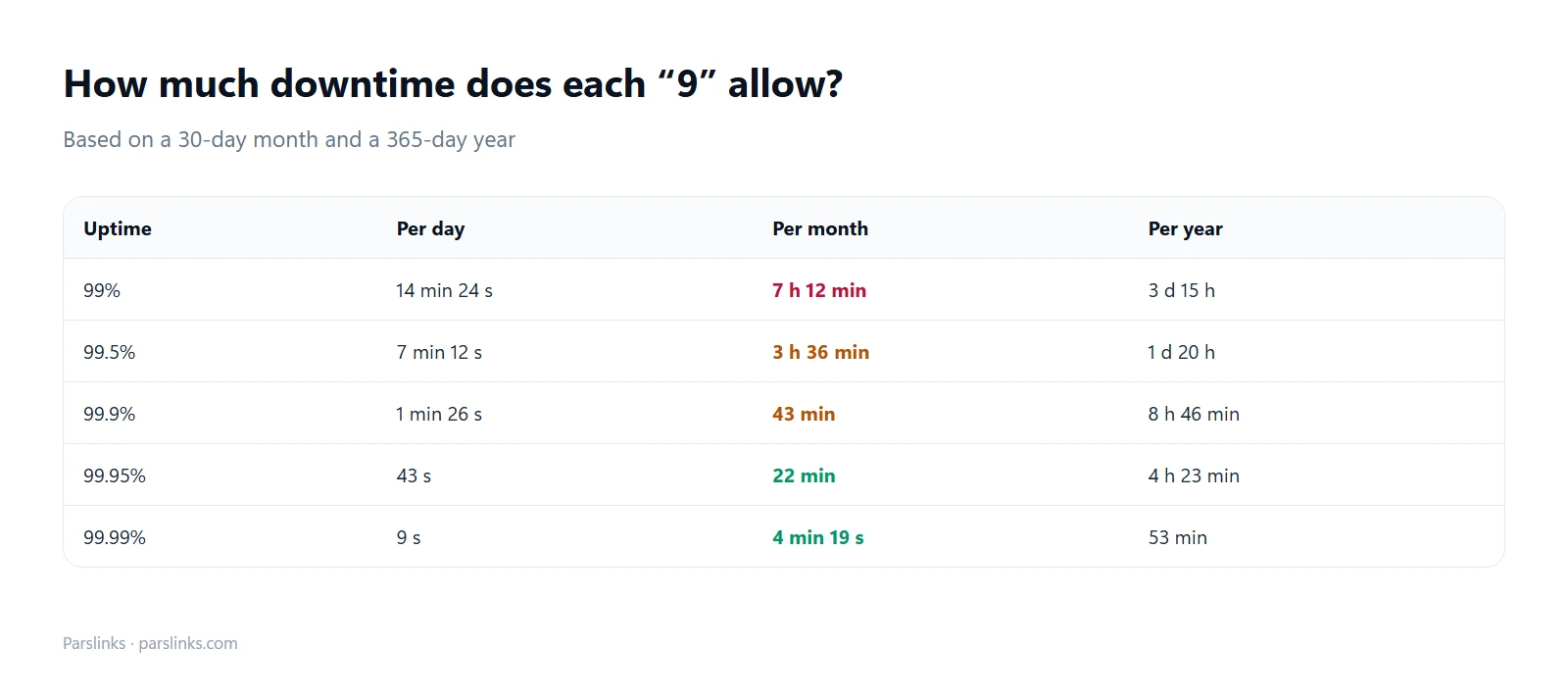
Read the table like this: 99.9% means the provider promises you won't be unavailable for more than 43 minutes in a 30-day month. Those 43 minutes can come all at once (say 9pm on a Friday, mid-sale) or in several short pieces.
The gap from 99.9 to 99.99 is one digit, but it means ten times less downtime, and reaching it is roughly ten times harder: redundancy at every layer, multiple data centres, and a team on call around the clock. For most small and medium businesses, 99.9% is realistic and enough.
Five questions before you sign
The percentage is just the headline. The details are in these five questions:
1. What counts as downtime? Is severe slowness downtime, or only when nothing responds? What about 500 errors caused by the platform?
2. What about scheduled maintenance? Most SLAs exclude it. Ask how often, how long, and how much notice you get.
3. How precisely is it measured? If it's checked every five minutes, three-minute outages may never be recorded.
4. What's the compensation? Usually a percentage of that month's fee as credit, not cash, and never your lost sales. If you pay a small monthly fee and an hour of downtime costs you far more in sales, the SLA isn't your insurance.
5. Who has to claim? In many contracts you must file a claim with evidence within a set window; compensation isn't automatic.
Your app's uptime is a product of several numbers
Something people rarely consider: your app depends on several services, and total uptime is roughly the product of theirs. If the app host is 99.9%, the database 99.9% and DNS 99.9%, the full path in the worst case is about 99.7%, or up to two hours and ten minutes of downtime a month.
| Link in the chain | Assumed uptime | Cumulative path uptime |
|---|---|---|
| App host | 99.9% | 99.9% |
| Database | 99.9% | 99.8% |
| DNS | 99.99% | 99.79% |
| Payment gateway | 99.5% | 99.29% (about 5 hours a month) |
And that still excludes the outages you cause yourself: a bad deploy, a wrong migration, a full disk. In practice, a large share of small teams' downtime comes from exactly these, not from infrastructure.
Measure uptime yourself
Don't rely on the provider's number. Have an external monitor (from somewhere outside your own infrastructure) check the home page and one critical path like /api/health every minute. For users in Iran, at least one check location should be inside the country; a site that looks fine from Germany may not load from Tehran.
In the health route, check something that actually matters to users, such as the database connection, but don't include slow external services.
Where to spend
On a limited budget, this order has the biggest effect on real uptime:
- Safe deploys: previews, promoting the same build, instant rollback. Most downtime comes from deploys.
- Monitoring and alerts: an outage seen after two minutes is very different from one seen after two hours.
- Tested database backups: a backup that has never been restored isn't a backup.
- Redundancy (two instances, a database replica), only after the three above.
Frequently asked questions
Join the discussion
No comments yet. Be the first to share your thoughts.
Related posts
- Deploy
Zero-downtime deployments in practice: rolling, blue/green, and promoting the same artifact
A restart is the simplest way to deploy, and the seconds the service is down are the seconds orders fail. This post lists where downtime really comes from, compares three common release strategies, and shows how to change your database without an outage.
- Platform
PaaS or a VPS? The real DevOps hours behind a small team's server
The VPS price is on the invoice. The hours spent on patches, SSL renewals, deploy scripts and midnight restarts are not. This post counts those hours, compares them with a platform, and is honest about when a VPS is still the better call.
- Platform
A Vercel alternative for teams in Iran: what it actually has to replace
Foreign-card payments, the risk of a suspended account and unreliable access to vercel.app push teams in Iran to look elsewhere. But renting a server and running next start covers only a small part of what Vercel did. Here is the full list, and how the alternatives compare.