
A Vercel alternative for teams in Iran: what it actually has to replace
Vercel isn't just "somewhere to run Next.js". If you're replacing it, first be clear about everything it was doing for you.
The demo is at 10am. You sent the client a preview link last night, and the reply comes in at breakfast: "It won't open." It loads fine on your office connection. On their mobile data, it doesn't. The link is on vercel.app, and ten minutes before the meeting you're working out how to take screenshots instead.
Many developers in Iran who work with Next.js know this moment well. Vercel built an excellent deployment experience, but for a team working inside Iran with Iranian customers it comes with serious obstacles. The useful question isn't "where do I get a server instead of Vercel?" It's what exactly was Vercel doing for us, and which of those things does a replacement need to cover.
What Vercel does in practice
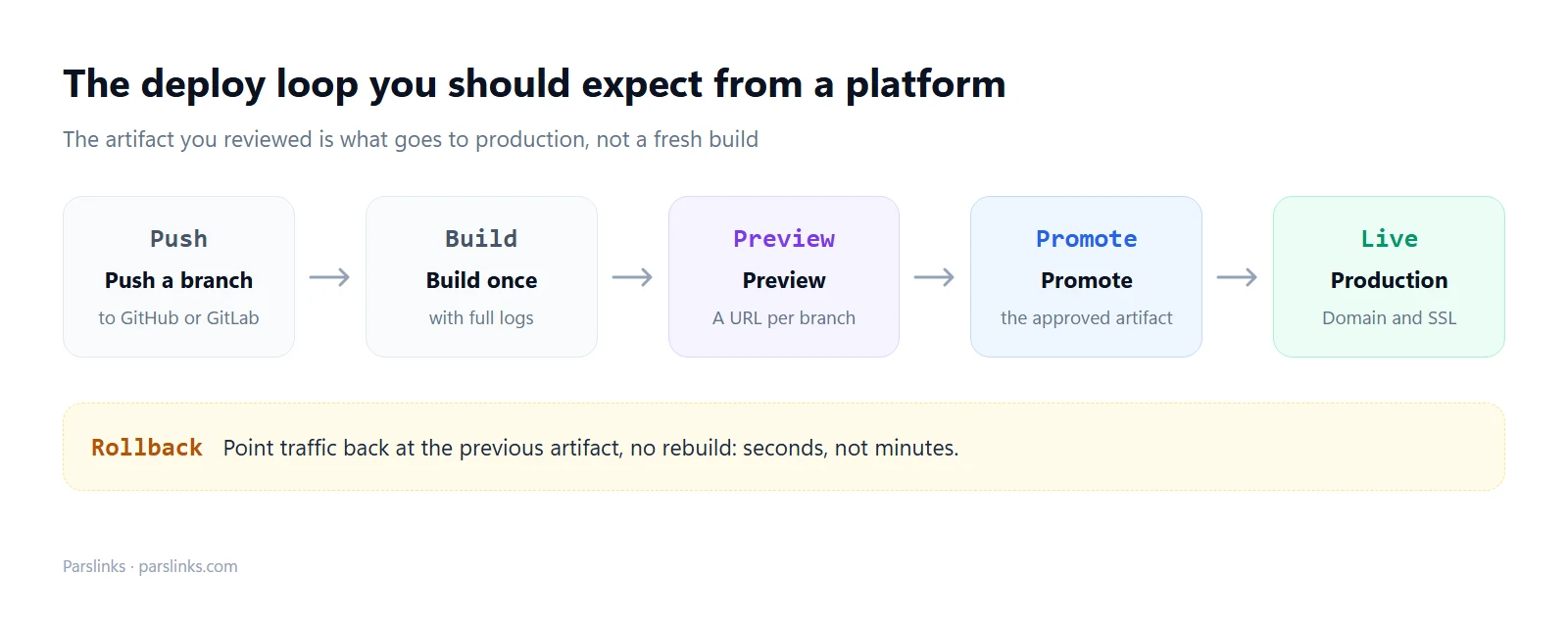
When you put a project on Vercel, a chain of things happens that you barely notice until it's gone:
- Builds from Git: every push gets a clean build with a pinned Node version and package manager.
- A preview per branch: every pull request gets its own URL.
- Immutable deployments: each build is a separate version; production simply points at one of them.
- Instant rollback: the previous version still exists, so rolling back means moving a pointer, not rebuilding.
- Automatic domains and SSL: you set a record and the certificate is issued and renewed for you.
- Full Next.js support: server rendering, ISR, image optimisation and middleware with no extra setup.
- Build and runtime logs in one place.
If the replacement is just "a server with Node.js", almost all of that list lands back on your team.
Why teams in Iran look for an alternative
Payment. Vercel's paid plans need an international card. For a team in Iran that means a middleman, fees, and exchange-rate swings at every renewal.
Account risk. Vercel is a US company bound by US sanctions law. Building a business on an account that could be restricted without warning is a risk most teams would rather not take.
The free plan isn't for commercial work. Under Vercel's own terms, the Hobby plan is for personal, non-commercial use. A client project on the free plan isn't where it should be.
User access. vercel.app domains have at times been disrupted or filtered inside Iran. A custom domain helps, but traffic still crosses international links, and during international internet disruptions the site becomes slow or unreachable for local users.
Latency. When most of your users are inside the country, Vercel's global edge network doesn't buy much; the nearest edge is still outside.
Three ways to replace it
In practice teams have three options, and each one is a different trade.
1. A VPS, configured by hand
You rent a server, install Node.js and Nginx, run the app with PM2 or systemd, and get certificates with certbot. You have full control and a low monthly bill. In exchange, branch previews, instant rollback and clean builds are scripts you have to write and maintain yourself.
2. An open-source platform on your own server
Tools like Coolify, Dokploy or CapRover give you a PaaS-like experience on your own machine: Git integration, automatic builds, domains and SSL. It's a good option if someone on the team is happy to maintain the tool itself, its updates and the server under it. Part of the ops work comes back; it just changes shape.
3. A managed platform
A service like Parslinks runs the whole loop: connect the repo, build, preview every branch, promote the approved artifact to production, roll back without rebuilding, and attach your own domain. You keep the code and project settings; the layers underneath belong to the platform.
| Capability | Vercel | VPS + manual setup | Open-source platform on your server | Parslinks |
|---|---|---|---|---|
| Automatic builds from Git | Yes | Via scripts or CI | Yes | Yes |
| Preview per branch | Yes | Usually not | Depends on the tool | Yes |
| Rollback without rebuilding | Yes | You build it | Depends on the tool | Yes |
| Custom domain and SSL | Automatic | certbot and upkeep | Automatic | Yes |
| Pay without a foreign card | No | Yes | Yes | Yes |
| OS and tooling maintenance | Vercel | You | You | Platform |
| Sanctions risk to the account | High | Low | Low | Low |
Five questions to ask any alternative
Feature lists on sales pages always look complete. These questions show the real differences.
Is production exactly what you saw in the preview?
Some services rebuild for production. That means the version you approved and the version you ship can differ, for example because a dependency released a new version in between. Promoting the same artifact removes that risk.
How long does a rollback take?
If rollback means "redeploy the previous commit", it takes minutes at best, and if the build process itself is what broke, it doesn't work at all. A real rollback takes seconds.
How do ISR and the Next.js cache behave?
ISR needs a Node server and a cache that persists between requests. If the app runs on several instances and each keeps its own cache, different users see different versions of the same page. Ask where the cache lives.
Are environment variables separate for previews and production?
A preview wired to the production database isn't a preview. It's a risk.
If I leave, what comes with me?
A project defined by standard install, build and start commands, or a Dockerfile, runs anywhere. A project tied to proprietary services doesn't.
Moving a Next.js project off Vercel
Most projects move without code changes. What to check:
vercel.json settings. If you defined redirects, rewrites or headers there, move them into next.config so they don't depend on the host.
import type { NextConfig } from "next";

const config: NextConfig = {
  output: "standalone",
  async redirects() {
    return [{ source: "/blog/:slug", destination: "/articles/:slug", permanent: true }];
  },
  async headers() {
    return [{ source: "/:path*", headers: [{ key: "X-Frame-Options", value: "DENY" }] }];
  },
};

export default config;
Environment variables. Pull a local copy of the project's variables with the command below and enter them in the new project's settings. Never commit the resulting file.
npx vercel env pull .env.production --environment=productionVercel's add-on services. If you used Vercel's own storage, database or analytics, they don't come with the project and need replacing, for example with S3-compatible object storage for files and a managed PostgreSQL for data.
The domain. Lower your DNS TTL a day before the move, bring the project up on the new host and test it fully on the preview URL, then switch the DNS record. Leave the Vercel project running for a few days.
The honest summary
If your team is outside Iran, your customers are too, and paying in dollars is no problem, Vercel is still a good choice and we see no reason to leave. If you work inside Iran, your users are Iranian, and you don't want your product to depend on an account that could be closed at any moment, look for an alternative that covers the whole loop: previews, promoting the same build, fast rollback and domains. Not just somewhere to run next start.
Frequently asked questions
Join the discussion
No comments yet. Be the first to share your thoughts.
Related posts
November 24, 2026
PaaS or a VPS? The real DevOps hours behind a small team's server
The VPS price is on the invoice. The hours spent on patches, SSL renewals, deploy scripts and midnight restarts are not. This post counts those hours, compares them with a platform, and is honest about when a VPS is still the better call.
November 24, 2026
Deploying Next.js to production: what SSG, ISR and SSR each need from your infrastructure
Each page's rendering mode decides what your server has to do. This post covers what SSG, ISR, SSR and PPR need from your infrastructure, how standalone output works, and what breaks once the app runs on more than one instance.
November 24, 2026
Zero-downtime deployments in practice: rolling, blue/green, and promoting the same artifact
A restart is the simplest way to deploy, and the seconds the service is down are the seconds orders fail. This post lists where downtime really comes from, compares three common release strategies, and shows how to change your database without an outage.